Contrary to popular belief AI is not about replacement, but about improvement through collaboration. If you are still dwindling between whether yp embrace AI or ignore it or even fear it…..then read on to know the reality of it.
While the growing misunderstanding around artificial intelligence is very evident in how variedly people are treating it either like a hype, a threat or even nothing more than a smarter calculator or writing assistant. The reality sits somewhere far more interesting. AI is quietly transforming from a tool into a collaborator, and this shift is already reshaping how work gets done across industries.
The real question is no longer whether AI will replace humans. That debate is outdated. The real question is whether humans are adapting fast enough to work alongside AI effectively. Because what we are witnessing is not replacement but multiplication. Those who learn to use AI as a co-pilot are increasing their output, speed, and impact dramatically, while those who ignore it risk being left behind in a world that is moving at an accelerated pace.
Well do not mistake this shift to be merely theoretical any longer. It is already visible in real-world data, company decisions, and everyday workflows.
The Shift From Tool to Collaborator
For years, technology has helped humans work faster. Email replaced letters, spreadsheets replaced manual calculations, and digital tools streamlined operations. AI is different because it does not just speed up work; it contributes to the work itself. It writes, analyzes, designs, suggests, predicts, and iterates.
That changes the role of the human completely. Instead of doing every task manually, humans are now directing, refining, and improving AI-generated output. This creates a partnership where the machine handles repetitive and predictable work, while humans focus on strategy, creativity, and decision-making.
Some leaders believe this shift is happening so quickly that we are already entering a new era of intelligence acceleration. The concept of the technological singularity, where AI begins improving itself at a rapid pace, is still debated, but one thing is clear: the speed of development is forcing individuals and businesses to rethink how they work.
The one thing that is very clear is – the future is not about competing with AI; rather collaborating with it.
Real Evidence That AI Multiplies Productivity
The strongest proof of this shift comes from productivity data across industries. Companies and organizations using AI are not shrinking; they are becoming more efficient and producing more value with the same or smaller teams.
Recent global research shows that generative AI could add trillions of dollars in annual corporate productivity value, especially in areas like software development, marketing, and customer operations. Industries with high AI adoption are seeing revenue per employee grow significantly faster than those that rely on traditional workflows.
Now, what does this data tell us then – AI is not simply cutting jobs – it is increasing the output of people who know how to use it.
Across organizations, the pattern is consistent:
- Employees save several hours every week using AI for routine tasks
- Developers complete more projects in less time
- Writers and analysts produce higher-quality output faster
- Customer service teams resolve issues quicker with AI assistance
In simple terms, AI is creating leverage. One skilled professional using AI can now perform the work that previously required a small team. That is certainly, a massive shift in productivity economics.
Companies Are Seeing Real Gains
Many organizations have already moved beyond experimentation and are integrating AI deeply into their workflows.
Companies are building AI-driven applications for sales analysis, customer retention, internal communication, and data processing. In several cases, thousands of work hours are being saved every month. Email processing time is dropping significantly, document handling is faster, and support queries are being resolved automatically with higher efficiency.
The key pattern in all successful cases is collaboration. AI handles repetitive tasks, while humans focus on complex problem-solving and decision-making. This balance is where real productivity gains happen. Organizations that treat AI as a support system rather than a replacement tool tend to see stronger and more sustainable results. This reinforces a simple truth: AI works best when it works with humans, not instead of them.
When Replacement Fails
Interestingly, some of the most important lessons come from companies that tried to replace humans completely with AI and faced serious setbacks. Several organizations reduced staff expecting AI to take over customer support, content creation, or operational roles. In many cases, quality dropped, customer satisfaction declined, and companies were forced to rehire employees or restructure their approach.
The problem was not AI itself. The problem was the assumption that AI could handle human nuance, empathy, judgment, and contextual understanding without oversight. Of course AI can manage structured and repetitive work efficiently, but it struggles with emotional intelligence, complex decision-making, and unpredictable situations. When companies removed humans entirely from the process, they lost the very qualities that made their services reliable and trustworthy.
The lesson we need to learn is clear: full replacement often backfires, but human and AI collaboration delivers results.
Human Skills Are Becoming More Valuable
One of the most surprising outcomes of AI adoption is that human skills are becoming more important, not less. As AI handles routine work, the demand for uniquely human capabilities is increasing. Strategy, creativity, ethical judgment, communication, and domain expertise are now critical differentiators. Even the most advanced AI systems still require human supervision to verify facts, refine outputs, and make strategic decisions.
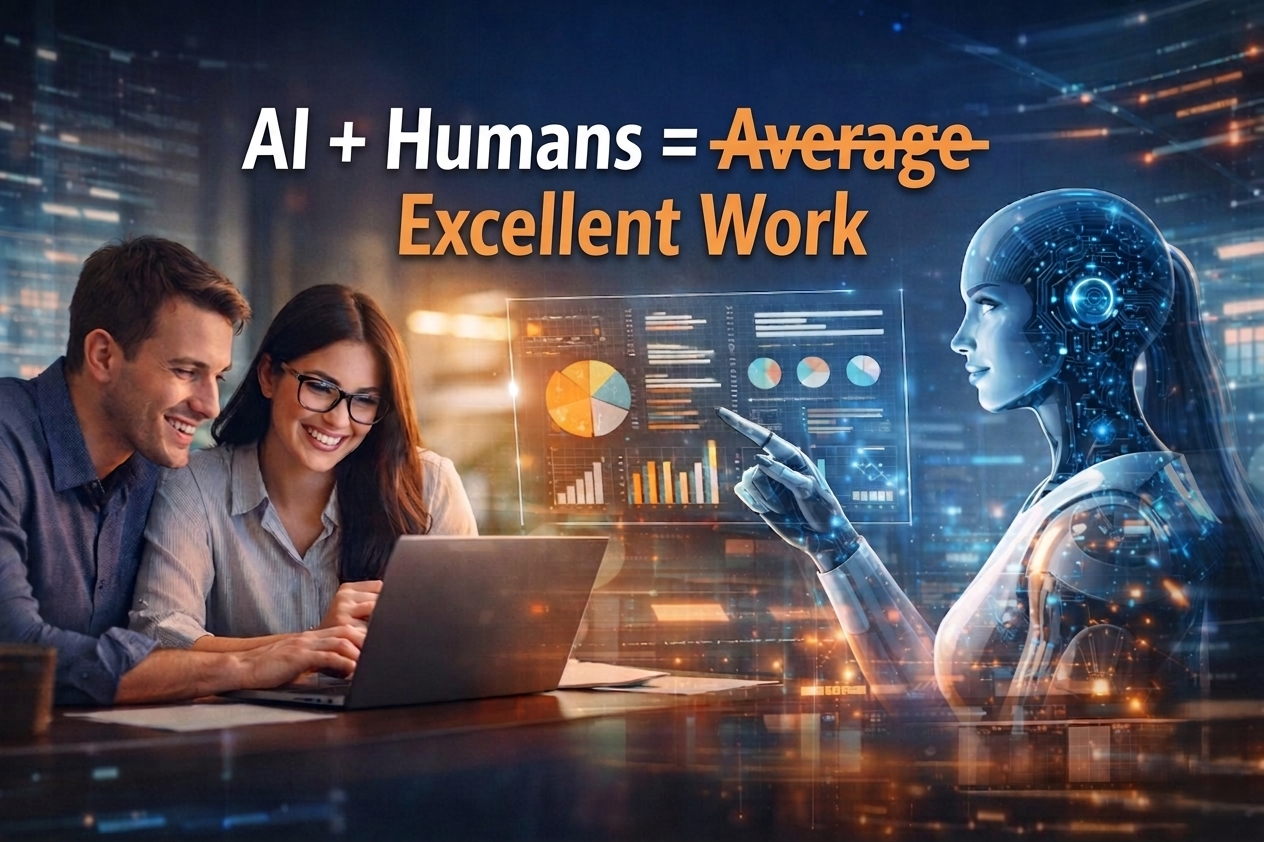
This means the future workforce will not be defined by technical skills alone. It will be defined by the ability to think critically, guide AI effectively, and apply human insight where machines fall short. In many ways, we could say, AI is raising the bar for what it means to be skilled. Average work is becoming automated, but exceptional thinking is becoming more valuable than ever.
Here’s How You Can Prepare Today
The transition to an AI-driven workplace is already happening, and preparation does not require complex technical knowledge. It starts with small, consistent changes in daily workflows.
- Treat AI as a co-pilot in everyday tasks. Use it for brainstorming ideas, drafting content, analyzing information, and improving efficiency. The goal is not to rely on it blindly but to use it as a starting point and refine the results.
- Focus on developing human strengths that AI cannot replicate easily. Creativity, strategic thinking, empathy, and problem-solving will continue to define successful professionals.
- Build AI literacy gradually by experimenting with prompts, understanding limitations, and learning how different tools work together. The more comfortable someone becomes with AI, the more leverage they gain in their work.
Most importantly, adopt a mindset of continuous learning. AI evolves rapidly, and the people who adapt quickly will always stay ahead.
The Future Is About Human and AI Friendship
The narrative of AI versus humans misses the bigger picture. The real divide is not between machines and people but between those who adapt and those who resist change. We must see clearly that AI is not eliminating human potential; it is expanding it.
Professionals who integrate AI into their workflows are already producing better results, faster outcomes, and more innovative solutions. Businesses that embrace collaboration between humans and AI are seeing measurable improvements in productivity and efficiency. The shift is happening quietly but steadily.
The future belongs to humans who learn to work with AI, not against it. And the preparation does not start tomorrow. It starts with experimenting today, integrating AI into one workflow, and gradually building a new way of working that combines human intelligence with machine capability. Because in this new era, the real advantage is not having AI – the real advantage is knowing how to use it.
To know more about how the world is changing towards collaboration with AI and not challenging it watch