
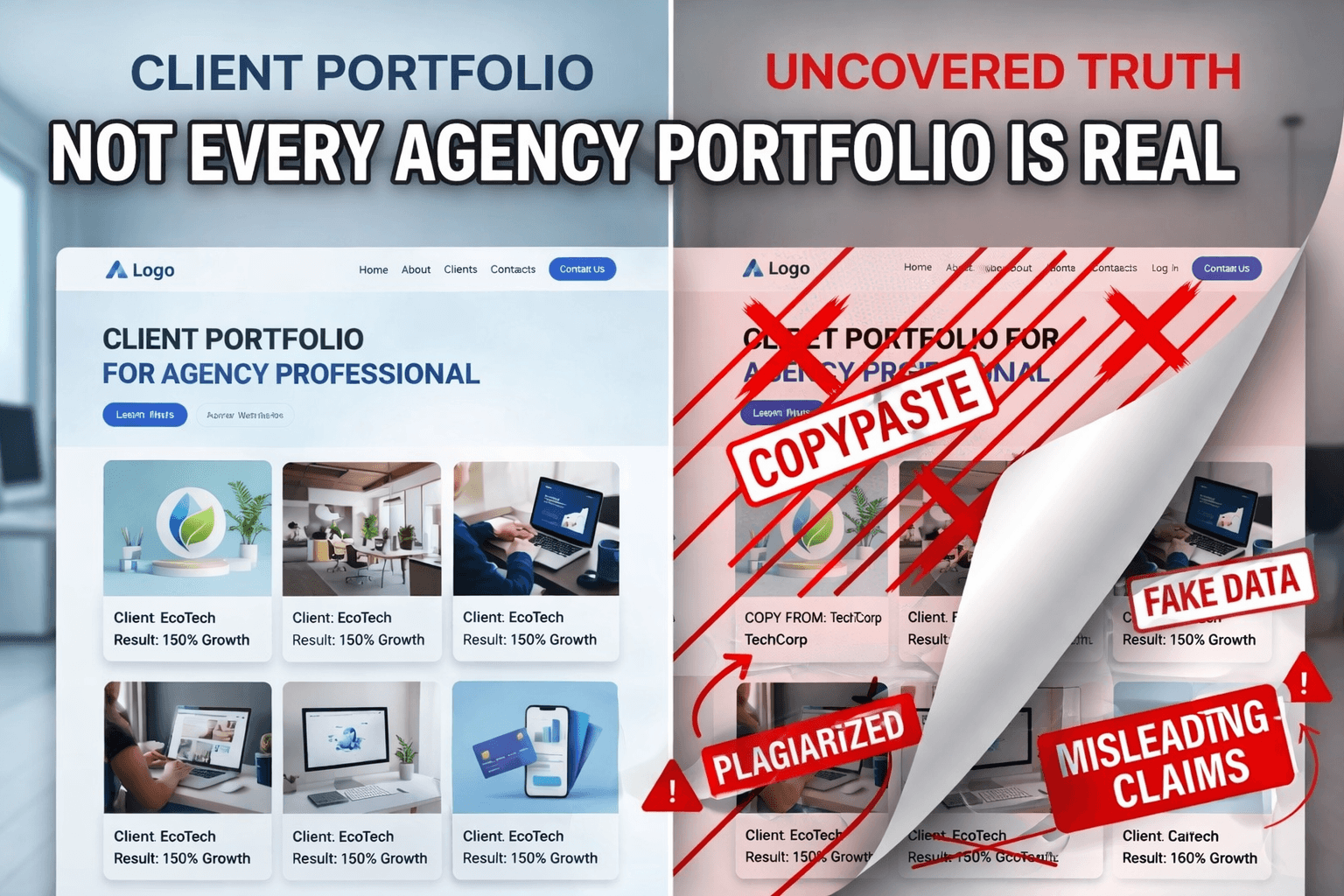
Hiring an agency can accelerate growth for a startup or small business. Whether the need is website development, marketing, design, or branding, agencies promise expertise and results that internal teams may not yet have. However, the agency ecosystem is crowded and highly competitive. In that environment, some firms exaggerate their capabilities or fabricate proof of experience to win projects.
For founders, the consequences of trusting the wrong agency can be severe. Budgets are wasted, timelines collapse, and the product or brand suffers reputational damage. Therefore, understanding how agency credibility can be manipulated is essential before signing any contract or paying an advance.
The Quiet Problem of Fake Portfolios
A portfolio is supposed to demonstrate real work and proven capability. Unfortunately, it has also become one of the easiest tools to manipulate. Some agencies assemble portfolios using stock designs, template-based layouts, or visuals taken from design platforms such as Behance or Dribbble. These materials are then presented as completed client projects even though they were never executed in real life. Fake case studies may include impressive claims such as dramatic traffic growth or revenue increases, yet the client names remain vague or impossible to verify.
A revealing experiment conducted by a freelancer involved verifying hundreds of online portfolios. The results were alarming. Only about one third of them were completely legitimate, while the remaining portfolios contained partially fabricated or entirely fake work.
Real world experiences confirm how widespread the issue has become. In one such case, a professional designer discovered that another freelancer had copied her exact portfolio projects and displayed them under a different name in order to secure client work. Another founder reported hiring a development agency after reviewing an impressive portfolio of enterprise dashboards. A simple reverse image search later revealed that several designs actually belonged to unrelated designers on public design platforms.
The pattern is clear. When portfolios showcase only polished final designs without showing sketches, iterations, or problem solving steps, the work may be more presentation than proof.
Why Misleading Testimonials Continue to Spread
Testimonials are powerful trust signals. A few enthusiastic quotes can persuade potential clients faster than technical explanations or project documentation. Unfortunately, this also makes them easy to misuse. Some agencies publish testimonials that cannot be traced to real companies or individuals. Others use generic praise that sounds convincing but contains no specific details about the project.
The challenge is that testimonials are rarely verified by prospective clients. This creates an environment where misleading endorsements can spread easily. In some cases, agencies even misrepresent relationships with public figures or creators in order to attract business. Reports from the creator economy show that misrepresentation by agencies and managers has caused creators and brands to lose significant business opportunities.
Therefore, testimonials should always be treated as starting points for investigation rather than final proof of credibility.
Red Flags Founders Should Watch Before Signing
While evaluating agencies, several warning signs tend to appear repeatedly in problematic engagements. Paying attention to these signals early can prevent expensive mistakes.
- Pressure to sign quickly
When an agency pushes for immediate commitment without allowing time for review, it often indicates a rushed sales strategy. - Vague performance claims
Statements about large increases in revenue or traffic must be supported with clear metrics and timelines. - Guaranteed outcomes
In fields such as search visibility or lead generation, guarantees ignore the complexity of real markets. - Unclear contracts
If an agency avoids sharing full contract terms in advance, important clauses may be hidden. - Shallow team profiles
Fake headshots, incomplete career histories, or unverified credentials can indicate that the agency is not what it claims to be.
Even infrastructure details can be misleading. Some fraudulent operations create the appearance of legitimacy using virtual office addresses or borrowed professional profiles to appear larger and more established than they really are.
How Founders Can Verify Real Case Studies
Fortunately, verifying an agency’s claims does not require advanced investigation. It simply requires curiosity and careful questioning.
Start by examining case studies closely. A legitimate case study usually explains the challenge, the strategy used to solve it, and the measurable outcome. It should also describe the role played by the agency.
Next, cross check the project externally. If an agency claims to have redesigned a website or developed a digital product, the final result should exist publicly.
Direct client references are also valuable. Speaking to past clients often reveals details about communication quality, project delays, and how challenges were handled. Genuine clients rarely hesitate to discuss their experiences openly.
Simple technical checks can also expose inconsistencies. Reverse image searches can reveal whether portfolio visuals originate from stock libraries or other designers.
What Serious Founders Should Demand Before Paying
Before transferring any advance payment, founders should ensure that a few basic safeguards are in place.
- Payments should be milestone based and linked to deliverables
- Contracts should allow sufficient time for review and legal input
- Intellectual property ownership should be clearly defined
- A small pilot project can help evaluate the agency before full engagement
- Direct interaction with the working team should be possible
Interestingly, reputable agencies often welcome these requests. Transparency signals that both sides intend to build a professional partnership rather than a quick transaction.
Learning More About Fake Agency Portfolios
The challenge of misleading portfolios and exaggerated case studies is not new, but it is becoming more visible as founders share their experiences publicly. The patterns are often the same. Polished presentations create the illusion of expertise, while the underlying proof remains weak or nonexistent.
If you would like to explore this topic further, the following video explains how fake portfolios are created, why they work, and what founders should look for when evaluating agencies.
Watch here:
https://www.youtube.com/watch?v=yE1cn5_FcSg
The video walks through several practical warning signs and real examples that illustrate how easily credibility can be manufactured online.
Understanding these tactics does not mean distrusting every agency. Instead, it encourages founders to approach partnerships with informed curiosity. In a marketplace where appearances can be carefully constructed, due diligence remains the most reliable protection.