The internet is entering a quiet but powerful transformation. For years, websites were built for humans to browse, click, and complete tasks step by step. Then search engines forced businesses to optimize for visibility. After that, user experience became the core focus, making interfaces smoother and easier to navigate.
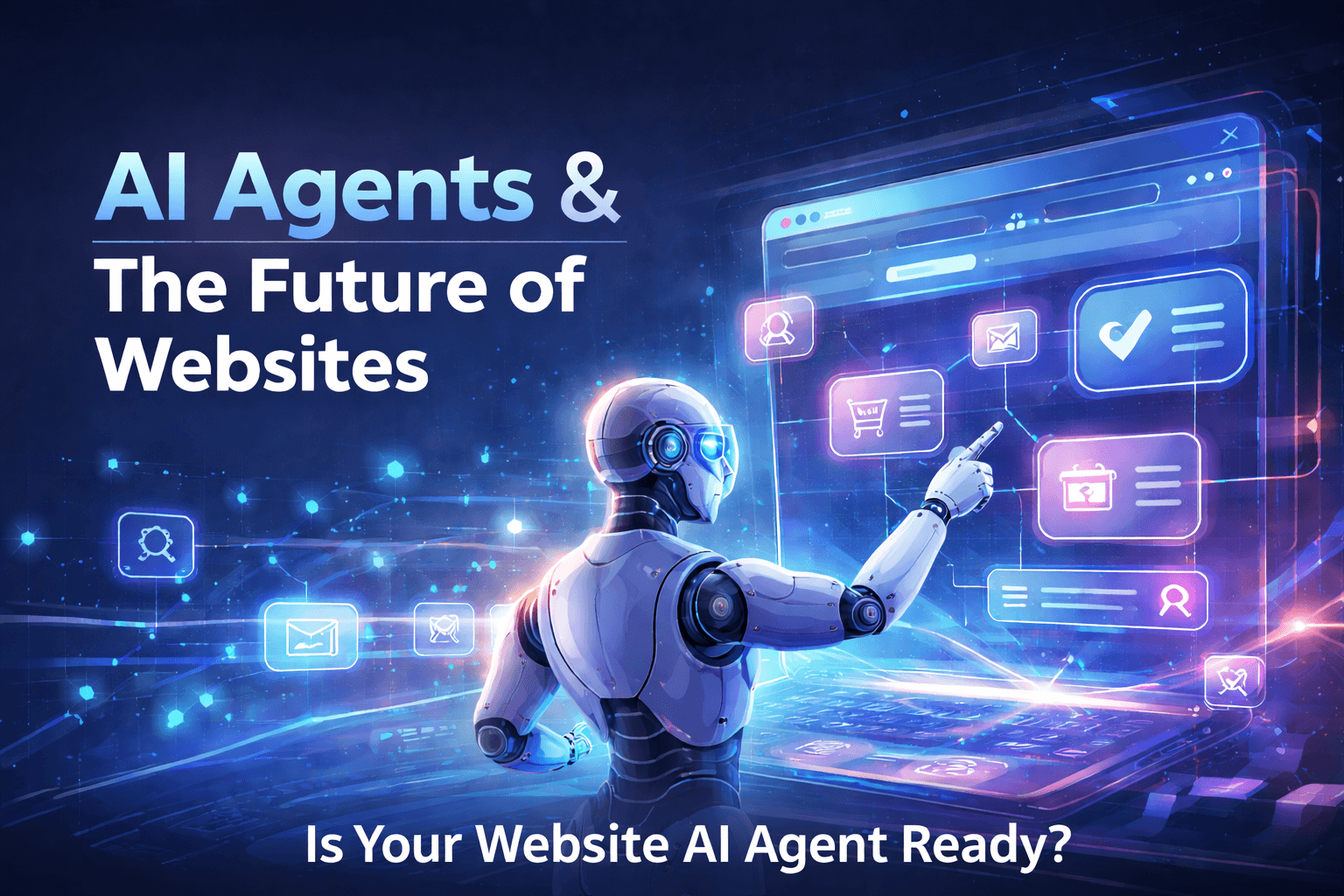
Now the web is moving into a new phase where websites are no longer built only for humans. They are being redesigned for AI agents that can actually perform tasks on behalf of users. This shift is not just technical. It is changing how customers interact with businesses, how transactions happen, and how digital platforms will compete in the future.
WebMCP and Agent Experience Optimization sit at the center of this transition, and businesses that understand this early will have a significant advantage in the coming years.
Understanding WebMCP in Simple Terms
WebMCP, or Web Model Context Protocol, is designed to remove guesswork from how AI agents interact with websites. Today, when an AI tries to use a website, it behaves like a human. It scans the screen, reads content, identifies buttons, and attempts actions based on visual cues. This process is slow, fragile, and easily breaks when a website layout changes.
WebMCP changes this completely by allowing websites to define structured actions that AI agents can directly use. Hence, instead of guessing, the website clearly exposes its capabilities. For example, a website can define actions such as:
- Search products using specific filters
- Add items to cart with defined quantity
- Submit support tickets with structured inputs
- Book services with clear parameters
- Process orders using secure session data
The AI agent simply calls these actions like an API, and the browser executes them in the live environment with access to cookies, sessions, and real time data. This removes the need for scraping, screenshots, or fragile automation and makes interactions faster and more reliable.
In simple terms, WebMCP turns a website into a structured and callable system that AI agents can use efficiently.
The Shift from SEO and UX to Agent Experience Optimization
To understand the importance of WebMCP, it helps to look at how the web has evolved over time. The first phase focused on discoverability. Businesses invested heavily in search engine optimization so their websites could appear in search results and attract visitors. The second phase focused on user experience, ensuring that once users arrived, they could navigate smoothly and complete tasks without friction.
Now a third phase is emerging, and it is centered on Agent Experience Optimization. This new phase is driven by a simple reality. Users are increasingly relying on AI assistants to perform tasks instead of doing everything manually. Rather than visiting multiple websites, comparing options, and filling out forms, users will instruct their AI to handle the process.
The optimization priorities are shifting:
- SEO helps search engines understand your site
- UX helps humans use your site
- AEO helps AI agents execute tasks on your site
This changes the competitive landscape. The websites that agents can use efficiently will naturally attract more transactions because they reduce friction and speed up execution. Just as structured data became essential for search engines, structured tool schemas will become essential for AI driven interactions.
How AI Agents Will Change Customer Interaction
The most significant impact of this shift will be visible in how customers interact with digital platforms. The traditional browsing journey is already starting to fade as AI agents take over repetitive tasks. In the earlier model, the process was straightforward but time consuming. Users visited websites, explored options, filled forms, compared prices, and manually completed transactions. Every step required attention and effort.
In the agent driven model, the process becomes simpler and faster. Users express their intent, and the AI handles discovery, comparison, and execution automatically. Orders are placed, bookings are completed, and support requests are submitted without the user navigating the website.
This creates a completely new interaction model where:
- Customers interact more with their AI assistant than with websites
- Transactions happen in the background
- Websites act as execution layers rather than visual destinations
- Reliability becomes more important than design
In this environment, the website that communicates its capabilities clearly to AI agents becomes the preferred choice, even if the human never directly visits it.
What Business Owners Must Do to Stay Ahead
The transition to agent driven web interactions is already underway, which means businesses need to start preparing now rather than waiting for it to become mainstream.
1. The first step is making websites agent ready by exposing structured actions that AI systems can use. Businesses should focus on high value functions that directly impact transactions and operations.
Key priorities include:
- Exposing search, booking, checkout, and support actions
- Writing clear and natural descriptions for tools
- Using structured and well defined schemas
- Implementing secure authentication and authorization
- Ensuring fast and reliable execution
2. The next step is monitoring how agents interact with the platform. Analytics should track tool usage, execution speed, and failure points so businesses can continuously improve performance.
3. Finally, businesses should think beyond their own website and consider how AI agents discover and compare platforms across the web. Becoming the most structured and reliable platform in a specific category creates a strong long term advantage.
This is not just about adopting a new technology. It is about building a system that AI can trust and execute without friction.
Why This Shift Is Bigger Than It Looks
At first glance, WebMCP may seem like a technical upgrade, but its impact is much deeper. It changes the role of websites in the digital ecosystem. The web is moving from being a place where humans perform actions to a system where actions are performed automatically on behalf of humans. This reduces friction, speeds up decision making, and makes digital interactions more efficient.
As a result:
- Discovery becomes automated
- Decision making becomes faster
- Execution becomes seamless
- Customer effort becomes minimal
In such a scenario, visibility alone is no longer enough. A website must be structured in a way that AI agents can understand and operate it effectively. Businesses that recognize this early will be better positioned to lead the next phase of digital transformation.
In a Nut shell
The web is evolving from a place where humans browse to a platform where agents execute tasks. WebMCP is making websites programmable, and Agent Experience Optimization is making them usable by AI systems. Together, they are shaping a future where transactions happen faster, interactions become seamless, and businesses compete on execution rather than just visibility or design.
Thus, companies that adopt this approach early will become the platforms that AI agents rely on every day. Those that ignore it risk losing relevance as digital interactions shift toward automation and intelligent workflows. The shift is already happening. The only real question is whether your website will be ready for it when AI agents start doing most of the work.
If you want to see how WebMCP works inside browsers and how AI agents will interact with websites in real world scenarios, this video provides a clear and practical explanation of the concept and its future impact.
Watch the full video here: