For years, businesses were encouraged to move toward off the shelf software because it promised something every growing company wanted: speed. Instead of spending months building internal systems, companies could simply subscribe to ready made platforms, configure a few workflows, and start operating almost immediately. Naturally, this changed the way businesses approached technology. CRMs replaced spreadsheets, SaaS based ERPs replaced fragmented systems, and cloud platforms became the default answer to operational scaling.
Initially, the model worked remarkably well because most businesses were focused on accessibility and affordability rather than operational precision. However, as companies grew, many of them began discovering a problem that does not appear during the onboarding stage of any SaaS product. The issue was never the software itself. The issue was what happened when unique business operations started colliding with standardized workflows.
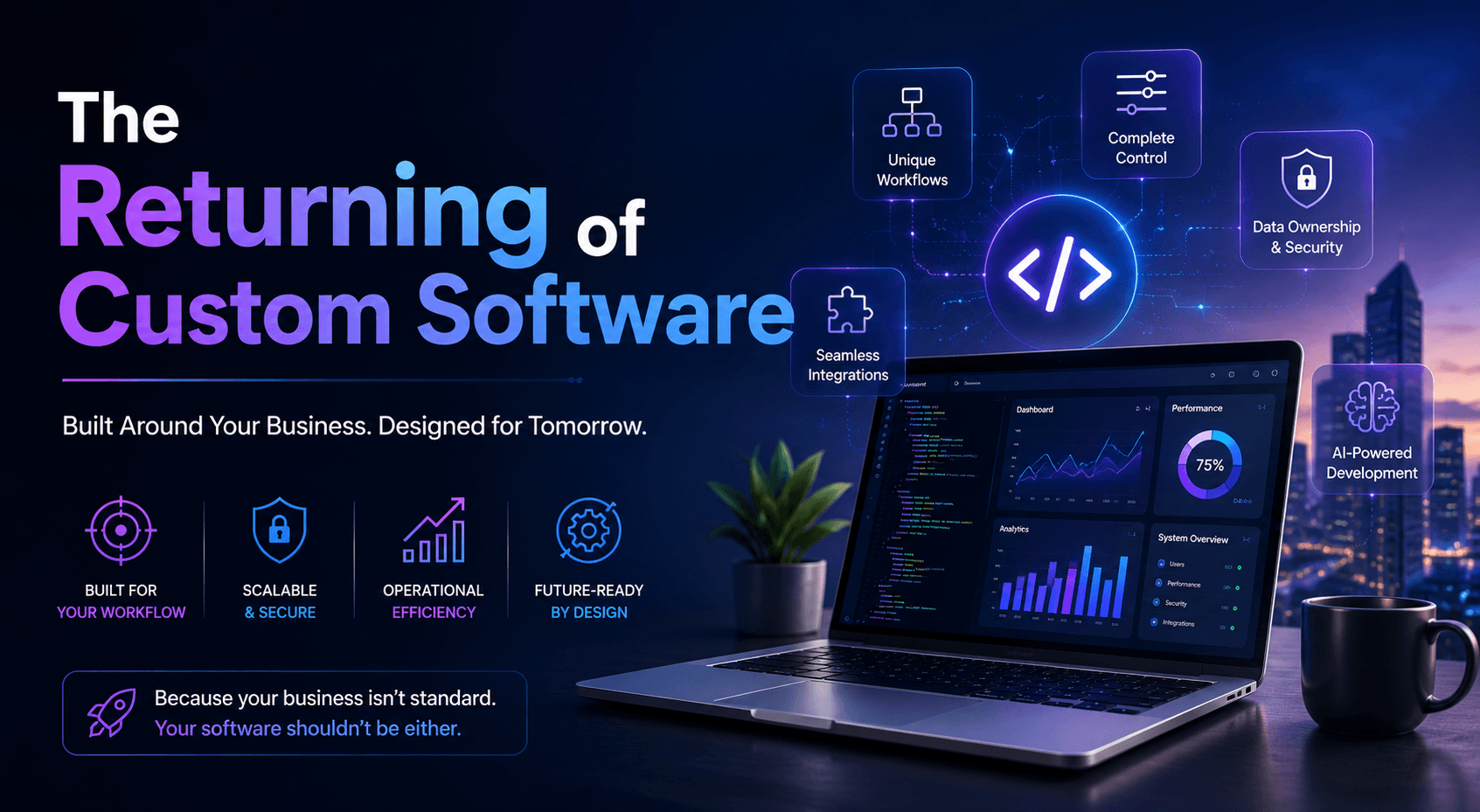
That realization is exactly why the conversation around custom software has changed so dramatically in 2026.
Businesses are no longer asking, “Should we use SaaS?” because the answer is obviously yes in many cases. Instead, they are beginning to ask a much sharper question:
“At what point does standardized software start limiting the way our business actually works?”
And interestingly, the answer usually does not appear all at once. It develops slowly over time. A company starts adding manual approval steps because the platform cannot support a specific workflow. Teams begin maintaining parallel spreadsheets because reporting structures are too rigid. Departments start exporting and importing data between systems because integrations are incomplete. Then eventually, employees spend more time managing operational gaps than actually executing efficiently.
At that stage, businesses are no longer benefiting from software simplicity. They are paying what many companies now call the off the shelf tax.
The Hidden Cost Most Businesses Ignore
The biggest misconception about SaaS platforms is that the subscription fee is the real cost. In reality, the subscription is often the smallest expense over time.
The larger cost appears operationally through:
- duplicated work
- fragmented reporting
- disconnected systems
- manual coordination
- workflow inefficiencies
- slower execution across departments
What makes this especially dangerous is that these inefficiencies rarely feel catastrophic individually. Instead, they accumulate quietly over several years until the business realizes its operations are being shaped around software limitations instead of business logic.
And this is precisely where custom software has started regaining relevance. Businesses are beginning to realize that software should support operational uniqueness rather than suppress it. However, unlike the early 2010s, the return toward custom development in 2026 is not happening because companies suddenly want giant enterprise systems. The shift is happening because AI has fundamentally changed the economics of building software itself.
AI Changed the Build vs Buy Equation
Historically, custom software carried a reputation for being expensive, slow, and risky. In many cases, that reputation was deserved because development cycles were long, prototyping was expensive, and experimentation required significant upfront investment. Today, that reality looks very different.
AI assisted development has dramatically reduced the time required to prototype workflows, automate repetitive coding tasks, and validate operational concepts. Businesses that once needed months to test an internal platform can now build working proof of concepts within weeks. As a result, companies are no longer forced into massive commitments just to explore whether a custom workflow might improve operations. However, this is where an important distinction needs to be made.
AI has accelerated development speed, but it has not replaced the need for architecture, scalability planning, or experienced engineering oversight. In fact, many poorly structured AI generated systems are already creating long term maintenance problems because businesses confuse “faster coding” with “better software.”
That is why the companies succeeding with custom software today are not the ones building everything from scratch. Instead, they are doing something far more strategic. They are identifying the exact operational layer that makes them different and building only that part.
The Businesses Winning with Custom Software Are Building Selectively
This is one of the most important shifts happening right now because successful businesses are no longer treating custom software as an all or nothing decision. Instead of replacing their entire ecosystem, they are selectively building around operational complexity that standard platforms cannot handle properly. A logistics company offers a perfect example of this.
Their delivery operations involved:
- location specific restrictions
- time sensitive delivery windows
- zip code based routing conditions
- customer specific unloading requirements
Traditional transport management systems could not accommodate these workflows effectively, which forced employees to manually adjust routes every week. Over time, dispatch inefficiencies became a serious operational bottleneck.
Now, many companies in this situation would attempt to replace their entire logistics stack. However, this company took a far smarter approach. Instead of rebuilding everything, they developed a lightweight custom dispatch layer that integrated directly into their existing ERP and mapping systems. That distinction matters enormously.
They did not build software because they wanted ownership. They built software because a very specific operational workflow directly impacted efficiency and scalability. And this is exactly where custom development creates the most value.
The Biggest Mistake Businesses Still Make
While custom software is becoming more viable, not every workflow deserves customization. In fact, this is where many companies still waste enormous amounts of time and money. There is very little strategic advantage in rebuilding systems that have already become industry commodities.
For example:
- basic CRMs
- accounting systems
- POS software
- document signing platforms
- standard HR workflows
These problems have already been solved at scale by mature platforms. Trying to custom build them often creates more maintenance burden than operational advantage.
One retail startup learned this lesson painfully after spending months building a fully custom POS platform when existing solutions already addressed most of their requirements. By the time the system launched, established vendors had introduced similar functionality through regular updates, leaving the company with a buggy internal platform and unnecessary development costs. The issue was not that custom software failed but that they built something that never made them operationally unique in the first place. And that distinction changes everything.
So What Should Businesses Actually Build?
The strongest custom software projects in 2026 usually solve one of four specific problems. More importantly, each of these problems directly impacts scalability, operational efficiency, or competitive differentiation.
- Unique Business Workflows
If a company’s competitive advantage depends on a process competitors cannot easily replicate, then forcing that workflow into generic software often creates operational friction. This is especially true in industries where process logic directly affects customer experience or revenue generation.
- Integration Gaps Between Platforms
Many businesses do not actually need entirely new systems. They simply need their existing systems to communicate properly.
In these cases, custom middleware, dashboards, or automation layers often create more value than replacing software completely.
- Security and Compliance Requirements
Industries such as healthcare, finance, and enterprise manufacturing often face strict compliance requirements that standard SaaS platforms cannot fully accommodate.
In these environments, operational control becomes a necessity rather than a preference.
- Growth Bottlenecks
Certain manual workflows work perfectly at smaller scales but collapse as businesses grow. When operational expansion starts increasing manual coordination exponentially, automation becomes essential.
And this is where focused custom development often produces the highest ROI.
The Healthcare Example Explains the Shift Perfectly
A healthcare clinic struggling with patient onboarding faced a challenge that most scheduling platforms simply could not solve effectively. Their appointment allocation depended on insurance verification workflows involving payer specific conditions, approval logic, and dynamic slot releases.
As patient volume increased, the manual process became unsustainable.
The clinic was losing potential appointments not because demand was low, but because verification delays slowed scheduling operations dramatically.
Now, this is where many businesses make another critical mistake. They assume solving the issue requires rebuilding their entire infrastructure.
Instead, the clinic focused on building only the workflow creating operational friction.
Their custom solution automated:
- insurance verification
- conditional scheduling
- queue based approvals
- slot allocation workflows
- audit tracking and compliance logging
As a result, onboarding speed improved significantly while maintaining stronger operational control over patient data and compliance processes.
Most importantly, they did not build an entire healthcare ecosystem.
They built one sharp operational edge.
And that mindset reflects the broader shift happening across industries right now.
Why This Trend Matters More Than Ever
The return toward custom software in 2026 is not happening because businesses suddenly dislike SaaS platforms. In fact, SaaS remains essential for standardized operations. What has changed is that companies are becoming far more intentional about where customization actually creates value.
AI has lowered the cost of experimentation, accelerated development timelines, and made operationally focused software far more accessible than before. However, the real advantage does not come from building more software.
It comes from building the right software.
The businesses seeing the strongest results today are the ones identifying the exact workflows that define their operational advantage and strengthening those areas strategically while continuing to use standardized tools everywhere else.
In other words, custom software is no longer about replacing everything.
It is about protecting the operational logic that makes your business difficult to replicate in the first place.
To know more on this watch –