AI Is Not Running Out of Compute – It Is Running Out of Storage
For a long time, the conversation around AI was dominated by compute. GPUs were scarce, expensive, and seen as the ultimate bottleneck. Whoever controlled compute had the advantage. That was the narrative driving decisions, investments, and infrastructure planning.
But that narrative is quietly shifting, and the change is more fundamental than it appears.
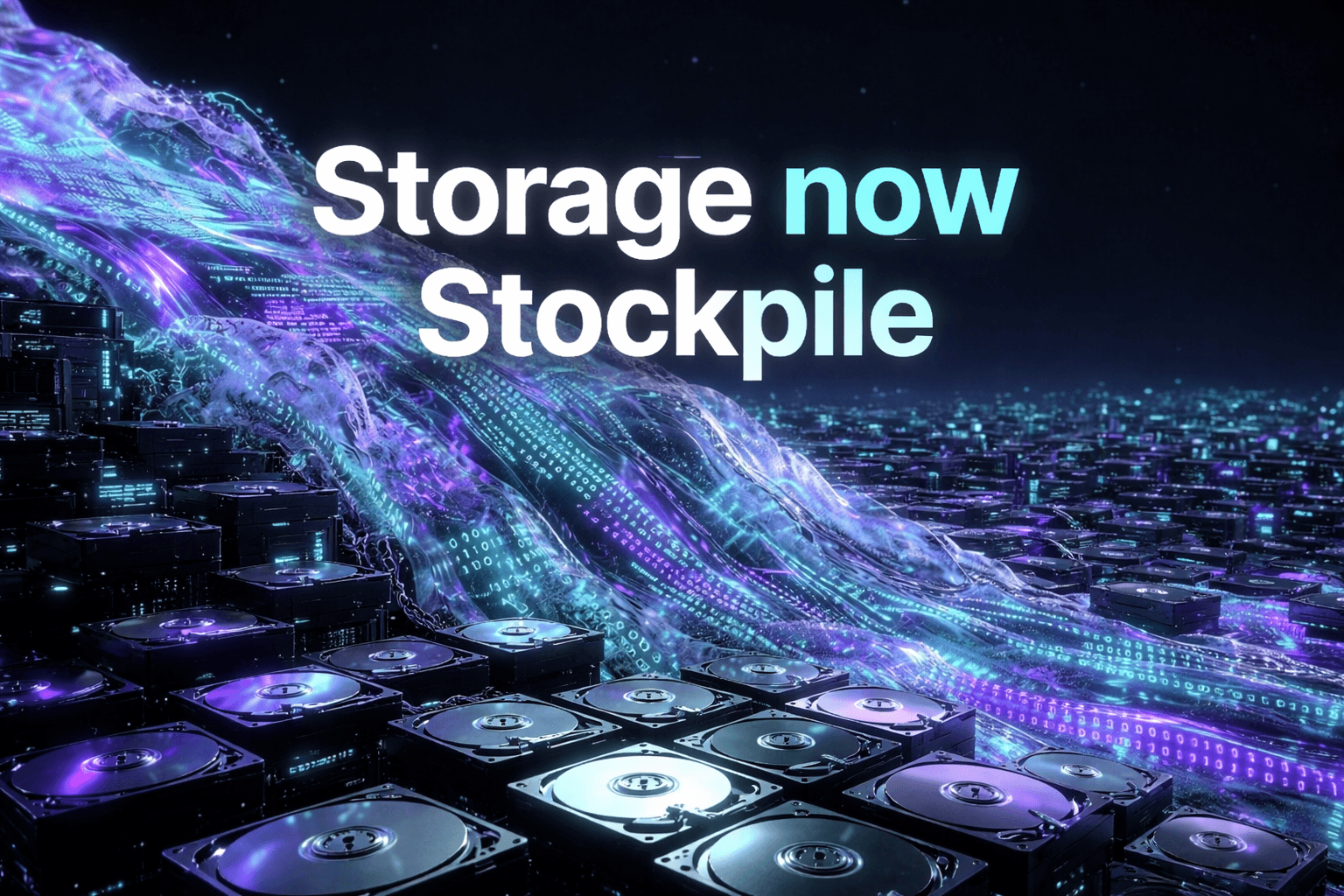
AI is no longer just constrained by how fast it can process data. It is increasingly constrained by where all that data goes once it is created. Every interaction, every response, every generated output, and every automated workflow adds to a continuously expanding pool of information. Unlike traditional systems where data could often be discarded or archived without consequence, AI systems depend on this data for future learning, optimization, and performance improvement.
This is turning storage from a backend utility into a core strategic resource.
The Real Explosion Is Happening After Deployment
It is easy to assume that the biggest data challenge in AI comes from training models, but that is no longer the case. Training is intensive, but it is finite. What follows is continuous, and that is where the real pressure begins.
Modern AI systems operate in a loop. They respond to users, generate outputs, log interactions, and feed those interactions back into future improvements. As usage increases, this loop accelerates. The volume of data being generated is no longer periodic; it is constant and compounding.
This shift is further amplified by the rise of agent-driven workflows and multimodal systems. AI is no longer limited to text. It processes and generates images, videos, and complex data streams, each significantly larger in size and more demanding in storage. What used to be manageable at scale is now expanding faster than most infrastructure was designed to handle.
As a result, storage is not just keeping up with AI. It is struggling to keep pace with its growth.
Why Traditional Storage Is Back at the Center
At first glance, one might expect cutting-edge storage technologies to dominate this space. However, the economics of scale tell a different story.
Not all data generated by AI needs instant access. A significant portion of it is “cold” or semi-active, meaning it is stored for future use rather than immediate processing. For this category of data, cost efficiency matters far more than speed.
This is where traditional hard disk drives have re-emerged as a critical component. While they lack the speed of modern alternatives, they offer unmatched cost efficiency at scale. When companies are dealing with petabytes or even exabytes of data, even small differences in cost per unit become significant.
Hyperscalers are therefore building massive data repositories designed to store vast amounts of information at the lowest possible cost. These are not short-term solutions. They are long-term infrastructure investments intended to support the next phase of AI growth.
The Supply Reality That Changed Everything
The seriousness of this shift became clear when leading storage companies began sharing their outlook. Western Digital indicated that its production capacity is effectively committed well in advance, with major customers securing supply through firm purchase agreements. At the same time, Seagate Technology reported that its available capacity is also fully allocated, leaving little room for additional demand in the near term.
What stands out is not just the scale of demand, but the nature of it. These are not short-term purchases driven by immediate needs. They are long-term commitments extending years into the future, made by companies that cannot afford uncertainty in their infrastructure.
This signals a structural shift. The demand for storage is no longer cyclical or reactive. It is planned, secured, and treated as a foundational dependency for AI growth.
How This Quietly Impacts Everyone Else
While this may appear to be a challenge limited to large technology companies, its effects extend far beyond data centers.
When a small group of hyperscalers secures a significant portion of global storage capacity, the remaining supply becomes constrained. This imbalance gradually affects pricing and availability across the broader market.
Consumers and businesses begin to feel this in subtle ways. Storage-heavy devices become more expensive, configuration upgrades carry higher costs, and overall hardware pricing starts to rise. These changes may not always be immediately noticeable, but over time they become difficult to ignore.
The key point is that this is not an isolated issue. It is a ripple effect caused by a shift at the top of the supply chain.
What Businesses Need to Start Thinking About
For businesses adopting or building AI-driven solutions, this shift introduces a new layer of consideration. It is no longer enough to focus solely on features, performance, or user experience. Infrastructure planning now plays an equally critical role.
Organizations need to understand how much data their systems generate, how long that data needs to be retained, and how efficiently it can be stored. These decisions directly impact costs, scalability, and long-term sustainability.
A few practical considerations naturally follow:
- Planning infrastructure requirements in advance rather than reacting to growth
- Allocating budgets with the expectation of rising storage and hardware costs
- Optimizing data usage through compression, tiered storage, and efficient architectures
- Avoiding over-reliance on a single vendor or supply source
These are no longer optional optimizations. They are becoming necessary steps to ensure operational stability.
A Larger Shift That Is Still Underestimated
What we are seeing today is part of a broader transformation in how digital infrastructure is evolving.
AI is not just a software advancement. It is a force that is reshaping the entire technology stack, from compute to storage and beyond. Each layer that becomes constrained reveals the next one as the new bottleneck.
First, it was compute. Now, it is storage. In the near future, other elements such as power and physical infrastructure are likely to face similar pressure.
Understanding this progression is important because it highlights a simple reality. Success in the AI era will not depend solely on building better models. It will depend on building systems that can sustain and scale those models effectively.
Summing It Up
AI is generating data at a scale that far exceeds previous technological shifts. This data is not temporary. It is integral to how systems learn, improve, and operate over time.That is why leading companies are not just investing in storage. They are securing it well in advance, treating it as a critical resource rather than a commodity. What appears to be a supply constraint is, in reality, a reflection of how essential storage has become in the AI ecosystem.
And as this trend continues, one thing becomes increasingly clear. In a world driven by AI, the advantage will not belong only to those who build the smartest systems. It will belong to those who ensure those systems have the capacity to keep growing without limits.
To know more about this life transforming transition watch: