
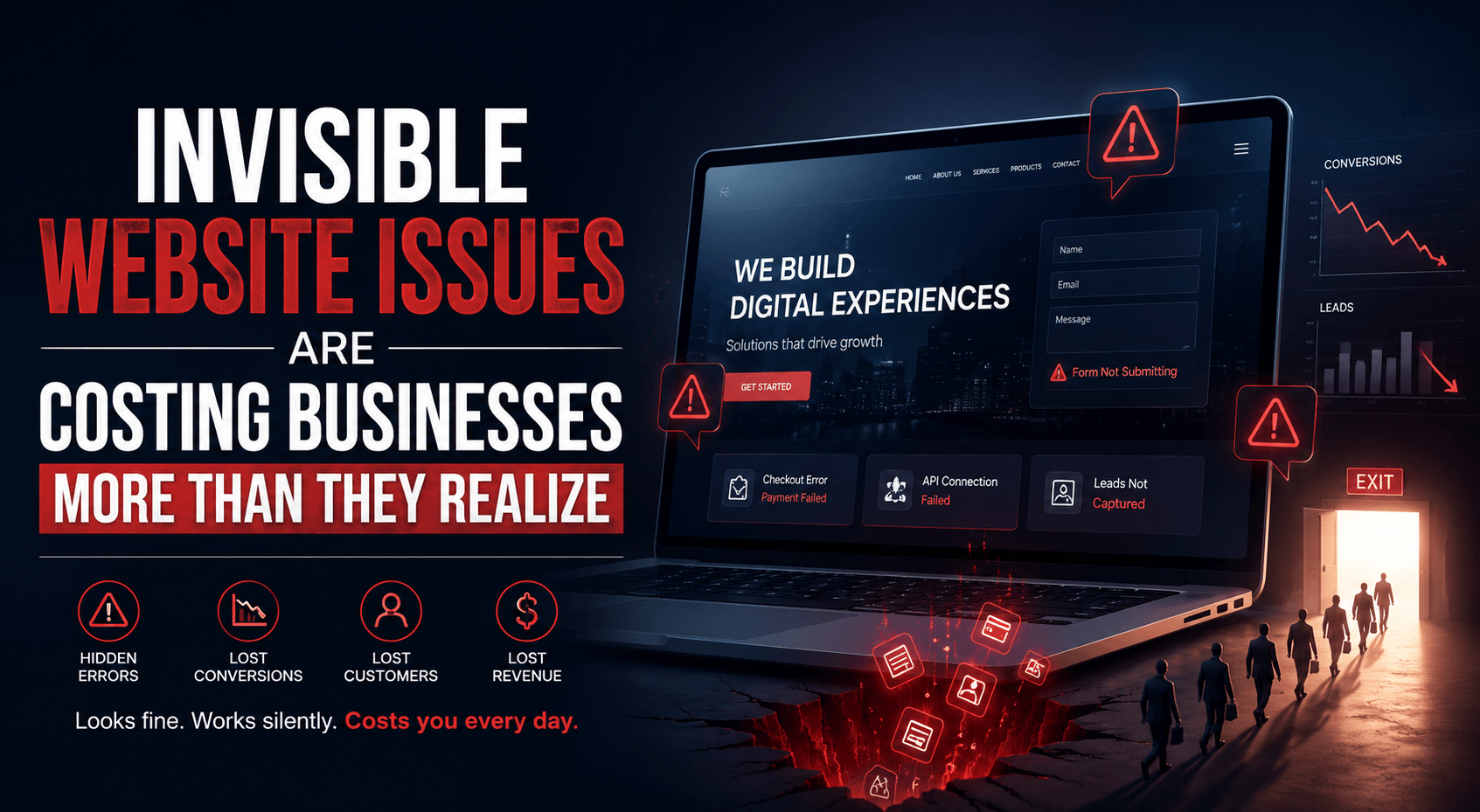
Most Businesses Look at Marketing First and Infrastructure Later
When business growth begins slowing down, most companies instinctively look outward for answers. Marketing campaigns are reviewed, ad budgets are increased, SEO strategies are questioned, and sales teams are pushed harder because traffic and lead generation feel like the most obvious areas to investigate. In many cases, businesses spend weeks trying to optimize acquisition channels without realizing that the real problem may not be visibility at all.
The traffic may already be arriving exactly as expected, and users may already be interested in the product or service being offered. However, the issue often begins much later in the customer journey, where unnoticed technical failures quietly interrupt conversions without creating obvious internal alarms. Because these failures rarely announce themselves dramatically, companies continue operating under the assumption that their website is functioning properly while potential customers leave silently in the background.
Why Invisible Website Issues Are More Dangerous Than Obvious Failures
This is what makes operational website issues so dangerous in 2026. Unlike older system failures that caused complete crashes or visible downtime, modern digital problems are often subtle enough to remain undetected internally while still damaging business performance externally.
A contact form may stop forwarding submissions under certain conditions. A checkout process may fail only on specific mobile devices. A payment gateway might timeout intermittently during peak traffic hours. Sometimes a CRM integration silently breaks in the background, causing leads to disappear before the sales team even sees them.
From the company’s perspective, the website still appears live and functional because pages continue loading normally. However, from the customer’s perspective, the experience becomes frustrating enough to abandon entirely. The difficult part is that users rarely report these issues directly anymore. Most customers do not pause to explain why they left a website. They simply move on to the next available option, often without returning.
A Website Is No Longer Just a Branding Asset
Because of this behavior, businesses frequently misdiagnose the real source of declining conversions. Instead of questioning whether the website infrastructure itself is leaking opportunities, they focus almost entirely on acquisition metrics. Marketing performance becomes the target of scrutiny while the operational system responsible for converting visitors quietly continues malfunctioning underneath.
This shift in perspective is important because websites are no longer functioning as static branding assets. A modern business website operates more like a live operational environment connected directly to:
- lead generation
- CRM workflows
- automation systems
- payment processing
- customer onboarding
- analytics
- sales operations
Once businesses begin viewing websites as business systems rather than visual deliverables, the conversation around performance changes entirely.
Why Beautiful Websites Still Fail Operationally
A visually polished website can still contain operational failures severe enough to affect revenue consistently. Clean interfaces, strong branding, and smooth animations often create the illusion that everything underneath is functioning correctly. However, technical reliability and visual presentation are not the same thing.
A site can look exceptional while still suffering from:
- backend logic failures
- incomplete tracking
- broken API calls
- inconsistent mobile behavior
- unstable integrations
- hidden checkout issues
This is one of the reasons many businesses struggle to identify technical losses early. The visible layer appears polished, so leadership teams naturally assume the operational layer must also be stable. Unfortunately, that assumption can become extremely expensive when conversion issues remain unnoticed for extended periods.
The Most Expensive Bugs Are Usually the Quietest Ones
One example that illustrates this clearly involved a SaaS company offering both monthly and annual pricing plans. The pricing page visually displayed the correct annual discount structure, and from a user experience perspective, everything appeared completely normal. However, the backend billing logic contained a silent issue that continued charging customers at the lower monthly rate even after annual commitments were selected.
The problem remained undiscovered for weeks because customers had no reason to complain about unexpectedly lower pricing. By the time the issue was identified internally, the company had already lost a substantial amount of recurring revenue.
Situations like this explain why relying solely on customer complaints is no longer enough. By the time users begin reporting problems publicly, the financial impact has often already accumulated quietly in the background.
Why Proactive Monitoring Matters More Than Reactive Support
This is also why proactive website monitoring has become increasingly important for businesses that depend heavily on digital operations. Traditional “post launch support” models tend to be reactive by nature, meaning businesses only investigate technical issues after customers begin experiencing visible frustration.
The problem with that approach is that the gap between failure occurrence and problem detection can directly affect revenue during the delay. As a result, many companies are now investing more seriously in proactive operational monitoring methods such as:
- automated error logging
- user session replay analysis
- synthetic monitoring
- regression testing
- performance diagnostics
- real time conversion tracking
These systems help businesses identify friction points earlier, often before operational losses become financially visible. More importantly, they shift the mindset from reacting to failures toward continuously validating whether the customer journey is functioning properly under real world conditions.
The Conversation Around Websites Is Changing
That mindset shift is becoming increasingly important because digital business infrastructure has grown significantly more interconnected over the last few years. A website no longer exists independently from the rest of the business ecosystem. Even relatively small technical inconsistencies can now affect multiple operational areas simultaneously, including lead acquisition, customer trust, analytics accuracy, automation workflows, and payment processing reliability.
This is why the conversation around websites is evolving beyond design quality alone. Businesses are beginning to understand that while branding and aesthetics still matter, operational reliability often has a far greater impact on long term performance. Generating traffic means very little if the infrastructure responsible for converting that traffic cannot perform consistently across devices, systems, and user conditions.
Final Thoughts
Ultimately, most businesses do not lose customers because nobody visits their website. They lose customers because something within the experience quietly breaks before conversion happens, and the problem remains invisible long enough to create measurable business damage.
Sometimes it is a failed form submission. Sometimes it is an unnoticed mobile issue. Sometimes it is a backend process that stops working silently after a software update. Whatever the cause may be, the pattern remains remarkably consistent: invisible technical problems eventually create very visible financial consequences.
And in an environment where businesses increasingly depend on digital systems for growth, assuming that a website is functioning correctly simply because it “looks fine” is becoming a far riskier assumption than many companies realize.
Take a look at this video to know more: