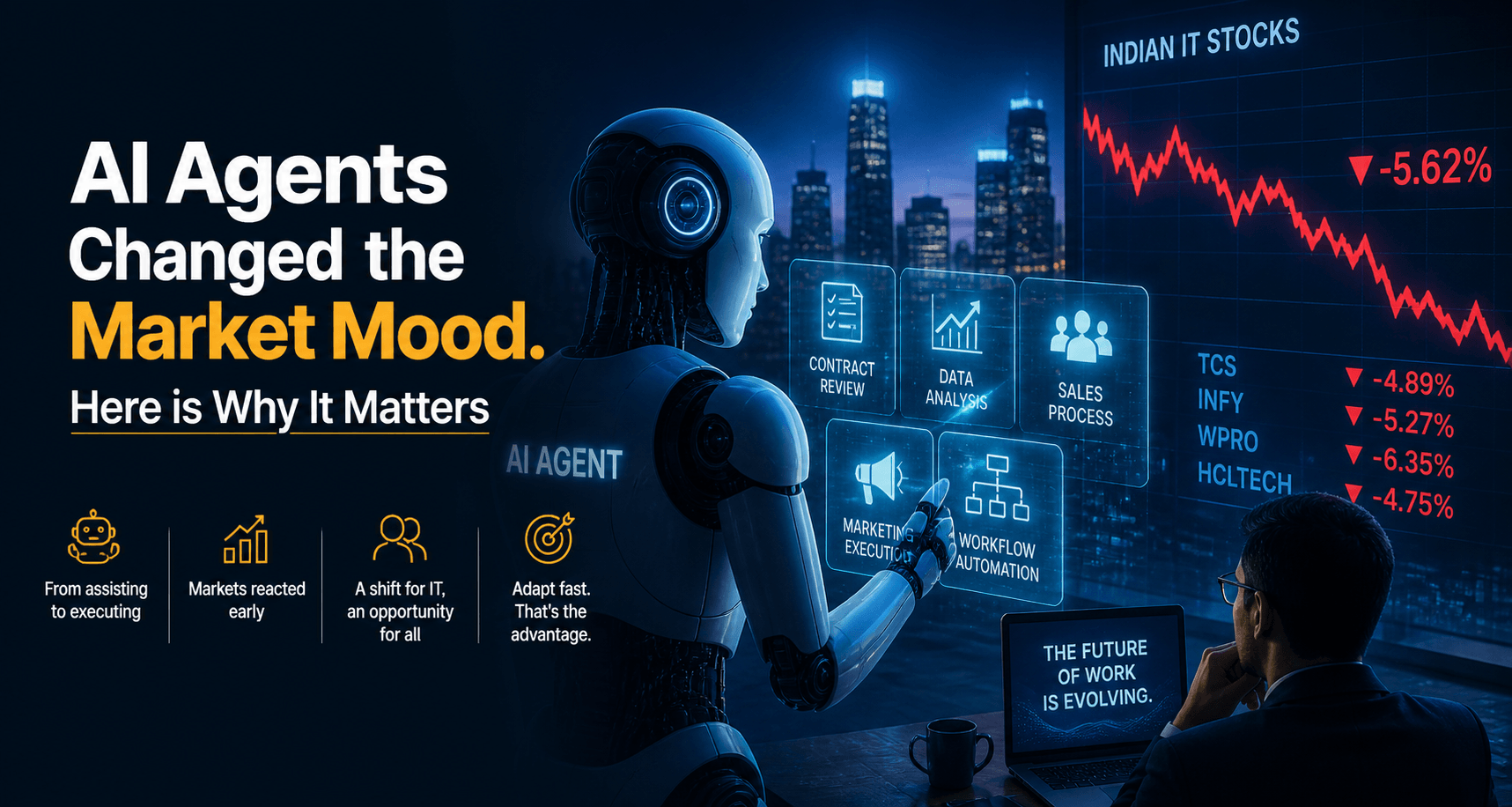
The recent dip in Indian IT stocks wasn’t driven by a recession scare or geopolitical shock. It was something more subtle, and arguably more important. Investors began pricing in a future where AI agents don’t just assist work rather they start doing it. This wasn’t panic at all it was an absolute forward-looking. It was a shift in how markets perceive the fundamentals of an industry that has, for decades, relied on scaling human effort; and that is what makes this moment worth paying attention to.
Repricing of Reality
When Anthropic showcased practical AI agents capable of handling real workflows such as contract reviews, sales processes, marketing execution, data analysis; it sent out a clear signal. These were not just theoretical tools but early glimpses of automation moving beyond assistance into execution.
The markets reacted accordingly and the Indian IT stocks saw a noticeable dip, wiping out billions in value within days. But calling it a crash would miss the point. This was a in fact, repricing of expectations, not a collapse. The underlying message to this was very simple: If work can be done faster with fewer people, the old growth models need to be re-evaluated.
Indian IT Experienced the Pressure First
Indian IT services have long thrived on a straightforward equation; they functioned on more demand equals more people, which drives more revenue. This labor-driven model has powered giants like TCS, Infosys, and others for years. But that model depends heavily on tasks that are structured, repeatable, and scalable. This is exactly where AI agents are starting to make an impact.
These systems don’t just respond to prompts. They can plan, execute multi-step processes, use tools, and iterate with minimal human input. Even if they’re not perfect yet, the direction is clear. For investors, that introduces uncertainty; and markets tend to react early when they sense that a company’s core advantage might weaken.
Look closely It Isn’t Replacement – It’s Compression
It’s tempting to frame this as humans versus AI, but that’s not quite accurate. What is happening is more nuanced. Work isn’t disappearing overnight on the contrary, it is becoming more efficient. Tasks that once required large teams could soon be handled with significantly fewer people, supported by AI. That means:
- Faster turnaround times
- Lower operational costs
- Reduced need for large-scale hiring
Even a 20–40 percent efficiency gain in certain workflows can start reshaping pricing models and margins. For companies built on “time and material” billing, this is where the real pressure begins.
What This Means for IT Services Companies
In the short term, volatility is expected. Every new advancement in AI agents will trigger fresh questions about productivity, pricing, and workforce requirements. But the longer-term picture is where things get interesting. The winners won’t be the ones resisting change. They’ll be the ones who redefine how value is delivered.
This means moving toward:
- AI-first delivery models instead of people-first scaling
- Outcome-based pricing rather than hourly billing
- Platforms and managed AI services instead of pure outsourcing
Many firms are already investing in this direction. The challenge however, is the speed. Markets aren’t just asking if they will adapt, but how quickly.
Founders Consider This As An Opening
While large IT firms deal with transformation, founders are looking at something entirely different opportunity. AI agents lower the barrier to building sophisticated products. Smaller teams can now execute ideas that once required significant resources.
The advantage shifts toward those who:
- Build domain-specific solutions where context matters
- Focus on reliability, orchestration, and real-world usability
- Solve practical problems rather than showcasing capabilities
There’s also a unique edge for Indian founders. Years of exposure to global outsourcing workflows mean they understand exactly where inefficiencies exist. That insight can translate into tools that don’t just replace services, but improve them. At the same time, competition intensifies. When building becomes easier, standing out becomes harder. Speed, clarity, and distribution start to matter more than ever.
Businesses, Delay Is the Only Real Risk
For business owners, this shift isn’t theoretical. It’s operational. AI agents are quickly becoming part of everyday workflows, not just experimental tools. The companies that benefit the most won’t be the ones waiting for maturity. They’ll be the ones experimenting early.
A practical approach starts small:
- Identify repetitive workflows that can be automated
- Test AI agents in controlled, low-risk environments
- Strengthen data quality and process clarity
- Combine AI efficiency with human judgment where it matters
This hybrid model — AI for scale, humans for nuance — is where real value begins to emerge.
A Structural Shift That’s Hard to Ignore
What we’re seeing isn’t just another layer of technology being added. It’s a fundamental shift in how work is organized and scaled. Traditionally, growth followed a predictable path, i.e. you hired more people, assigned tasks, and expanded output by increasing headcount. Scale was directly tied to team size.
That model is now being redefined. Instead of building larger teams, businesses can deploy AI agents to handle execution, while humans focus on oversight, decision-making, and exceptions. Growth no longer depends on linear hiring. This shift has far-reaching implications. It reshapes cost structures, changes how companies approach hiring, and redefines where competitive advantage actually comes from.
In a Nutshell
This moment is not about fear, it is about direction. AI is steadily moving from conversation to execution, shifting from assisting humans to actively participating in real workflows. Because of this shift, markets are reacting early. They are not responding to what AI is today, but to where it is clearly headed.
That does not mean Indian IT is fading away. It is evolving. The same strengths that built the industry, deep talent pools, operational scale, and strong client relationships, still hold value. But they now need to align with a different way of working, where efficiency and intelligence matter more than sheer headcount.
For founders and businesses, this shift is less of a threat and more of an opportunity. The tools to build, experiment, and compete are more accessible than ever, lowering barriers that once slowed innovation. As a result, the real divide is not going to be between humans and AI. It will be between those who adapt quickly and those who hesitate.
In a world where intelligence compounds, both human and artificial, the speed of adaptation may become the only advantage that truly lasts.