
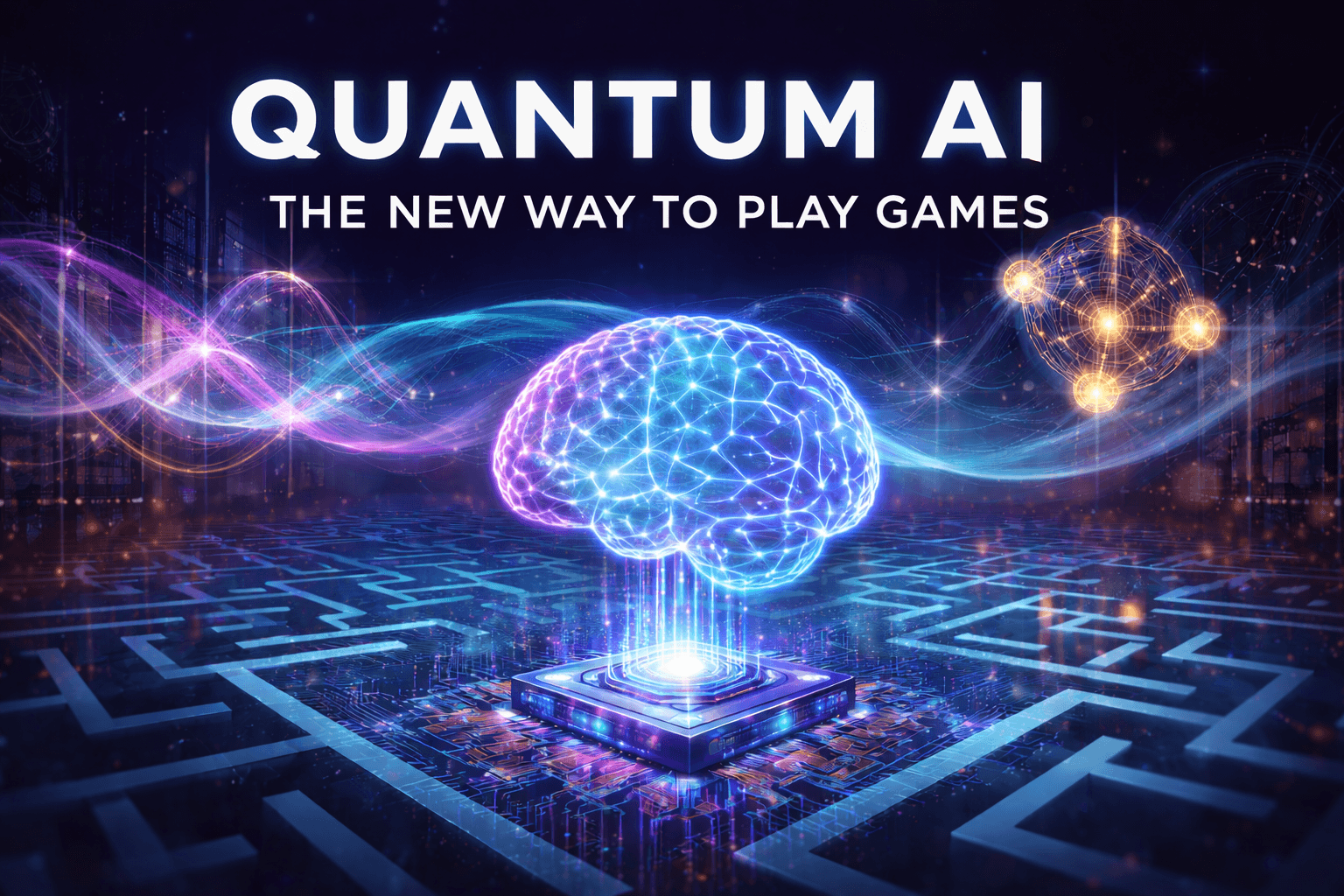
The conversation around Quantum AI is getting louder, but most explanations either overcomplicate it or oversell it. The reality sits somewhere in between, and it becomes far more compelling when you look at it clearly. This is not about building a faster version of today’s computers. It is about introducing a fundamentally different way of solving problems, one that changes how computation behaves at its core.
The Shift That Actually Matters
To understand why that matters, it helps to start with something familiar. Classical computers, the ones powering everything from your phone to large scale AI systems, process information in a linear and structured way. They move step by step, evaluating one possibility at a time. If you imagine a maze, a classical system behaves like a single explorer who tries one path, hits a dead end, turns back, and then tries another.
This approach works efficiently for simple problems, but as complexity grows and the number of possible paths increases exponentially, the process slows down dramatically. What once felt manageable quickly becomes computationally expensive, and in some cases, practically impossible.
How Quantum Computing Changes the Rules
Quantum computing, built on the principles of quantum mechanics, approaches this very differently. Instead of moving through possibilities one after another, it allows multiple possibilities to exist and interact within the same system. This shift does not simply improve speed; it changes the structure of problem solving itself.
Superposition Expands Possibilities
The first key concept is superposition. A quantum bit, or qubit, can exist in a combination of states instead of being locked into a single value. This allows the system to represent multiple potential outcomes at once, creating a much richer computational space.
Entanglement Connects Everything
The second concept, quantum entanglement, links qubits in a way that makes their states interdependent. Instead of processing variables separately, quantum systems can encode relationships directly into the computation, which becomes extremely valuable in complex scenarios.
Interference Guides the Outcome
The third idea is interference. Rather than simply searching for an answer, quantum algorithms are designed to amplify correct outcomes and suppress incorrect ones. This means the system actively shapes the probability of results, increasing the likelihood of meaningful answers when measured.
Where Quantum AI Fits Into the Picture
This is where Quantum AI begins to make practical sense. Traditional AI systems rely on classical computation to analyze patterns, learn from data, and optimize decisions. Quantum AI does not replace this foundation but enhances it by introducing quantum processes into the parts that are hardest to scale.
In real world applications today, this typically results in hybrid systems. Classical AI handles the bulk of the workload, while quantum components are used for specific challenges such as optimization, simulation, and high dimensional data processing.
It is important to stay grounded here. Quantum AI is not a universal upgrade. Its advantages show up in specific scenarios, particularly where complexity becomes difficult to manage using classical methods. Even well known approaches like Grover’s algorithm provide targeted improvements rather than blanket speed increases, and their effectiveness depends heavily on how the problem is structured.
The Maze Analogy, With a Reality Check
The maze analogy is widely used because it works. Classical systems explore one path at a time, while quantum systems allow multiple possibilities to exist simultaneously. However, this does not mean quantum computers magically try every path without effort.
They still rely on carefully designed algorithms, and the results are probabilistic rather than guaranteed. In many cases, computations need to be repeated to achieve consistent outcomes. The real advantage lies not in brute force exploration, but in how effectively the system guides itself toward useful solutions.
Where Quantum AI Actually Delivers Value
When applied in the right contexts, Quantum AI starts to show its real potential. The most promising areas are those where complexity, scale, and interdependence make classical approaches inefficient.
Some key areas include:
- Drug discovery and molecular simulation, where quantum systems can model atomic behavior more naturally than classical approximations
- Climate and weather modeling, where handling large, chaotic systems requires managing countless interconnected variables
- Traffic and logistics optimization, where multiple constraints must be balanced simultaneously across large networks
- Material science and energy development, including better batteries and more efficient materials
These are not everyday use cases, and that distinction matters. Quantum AI is not about improving routine digital experiences. It is about solving problems that are currently beyond reach.
The 2026 Reality Check
Despite the potential, the current state of quantum computing calls for a realistic perspective. As of 2026, the technology is still in its early phase, often referred to as the noisy intermediate stage. Systems are limited in scale, sensitive to errors, and typically designed for specialized tasks rather than general purpose computing.
This is why most real implementations today are hybrid. Organizations such as IBM and Google Quantum AI are working toward more stable and scalable systems, while D-Wave Systems is already applying quantum techniques to specific optimization problems.
What This Means Going Forward
What emerges from all of this is a more grounded understanding of Quantum AI. It is not a replacement for existing systems, nor is it an immediate transformation of everyday technology. Instead, it represents a new layer of capability that becomes relevant when problems reach a level of complexity that classical approaches struggle to handle.
The real shift, therefore, is not about doing the same things faster. It is about making entirely new categories of problem solving possible. That distinction matters, because it reframes Quantum AI from a buzzword into a meaningful technological direction.
If progress continues at its current pace, the long term impact will not be seen in small incremental improvements, but in breakthroughs that expand what we consider solvable in the first place.
Watch this video to know more: