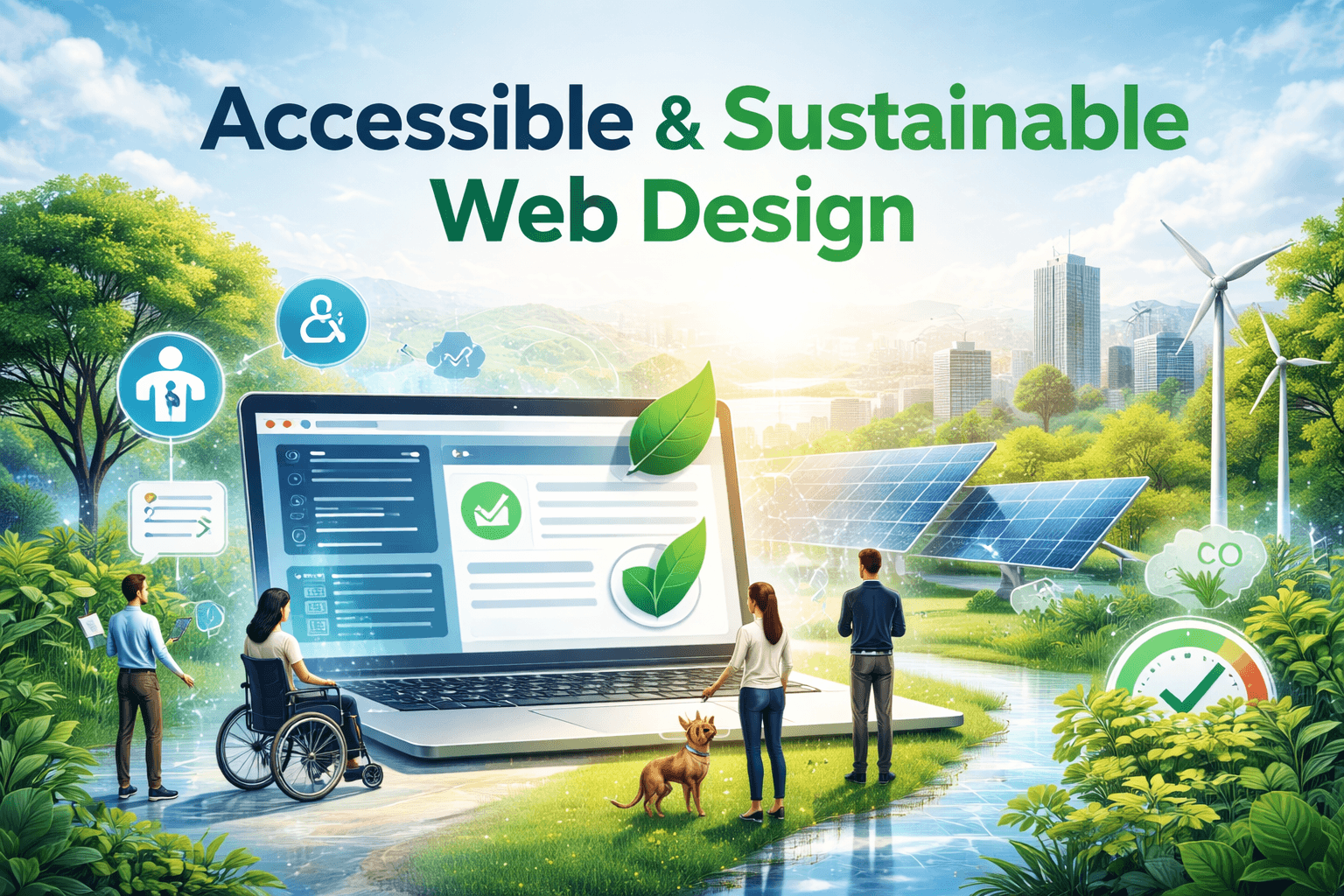
Brands today talk a lot about inclusivity, sustainability, and responsibility. It shows up in campaigns, reports, and messaging across every platform. But there is one place where those claims are tested instantly and without filters. Your website.
Because no matter what a brand says, users experience what it actually builds. And in 2026, two shifts are making that experience impossible to ignore: Accessibility-First design and Sustainable Web Design. These are no longer optional improvements added after launch. They are fast becoming the baseline for any serious digital presence.
Accessibility Is No Longer a Feature. It Is the Foundation
Accessibility used to be treated as a compliance checkbox, something handled late in the process or ignored unless required. That approach does not hold anymore. Accessibility-First means building with intention from the very beginning. It is about structuring websites so that they work seamlessly for everyone, including people with disabilities, without requiring workarounds or special adaptations.
At its core, this includes:
- Clear and semantic HTML structure
- Strong color contrast and readable typography
- Full keyboard navigation support
- Compatibility with screen readers
- Alignment with WCAG 2.2 standards
What is often underestimated is how much this improves the experience for all users, not just a subset. When navigation is logical, content is structured clearly, and interactions are predictable, friction disappears. And when friction disappears, performance improves across the board.
The Business Impact Is Hard to Ignore
Accessibility must not be considered as strategic decision but an ethical one. Websites built with accessibility in mind tend to perform better in search, engage users more effectively, and build stronger trust. Now, this is accidental – it is a direct result of cleaner structure and better usability.
The impact shows up in measurable ways:
- Improved SEO performance
Search engines understand well-structured, semantic content more effectively, leading to better indexing and visibility - Higher engagement and retention
Users stay longer and interact more when navigation feels natural and content is easy to consume - Stronger brand trust
A well-built, accessible website signals professionalism and reliability, which directly influences perception
At the same time, regulatory pressure is increasing. Accessibility is no longer just recommended. In many regions, it is enforced, and non-compliance carries real legal and financial risk.
The Hidden Cost of the Modern Web
While accessibility addresses inclusion, another issue has been quietly growing in the background. The environmental cost of the internet. Most businesses do not think about the carbon footprint of their websites, but the reality is difficult to ignore. The internet now contributes a significant share of global emissions, and every webpage, every interaction, and every load adds to that impact.
A typical webpage may seem insignificant, but when multiplied across thousands or millions of visits, the footprint becomes substantial. This is where sustainable web design comes in, not as a trend, but as a necessary evolution.
Sustainable Design Is About Efficiency, Not Sacrifice
Sustainable web design does not mean compromising on quality or creativity. It means eliminating unnecessary weight and inefficiency. The focus is simple. Build lighter, faster, and smarter.
This is achieved through:
- Optimized and compressed media assets
- Clean, minimal code without unnecessary dependencies
- Efficient loading strategies and architecture
- Use of content delivery networks for faster access
- Hosting on infrastructure powered by renewable energy
The result is not just a greener website, but a better one.
Faster load times improve user experience. Reduced data transfer lowers energy consumption. Efficient systems cost less to run and scale more effectively.
Sustainability, in this context, becomes a performance advantage.
Where Accessibility and Sustainability Converge
What makes these two shifts powerful is not just their individual impact, but how naturally they align. At the center of both is a single principle: clarity through efficiency.
- Accessibility encourages structured, meaningful code, which reduces unnecessary complexity
- Sustainability favors minimalism, which leads to lighter pages and faster performance
- Both reduce cognitive and technical load, improving usability and speed simultaneously
When done right, one reinforces the other. A well-structured website is easier to navigate, easier to process, and easier to load. It consumes less energy, performs better in search, and delivers a smoother experience across devices. This is not a trade-off, as a matter of fact, it is a convergence.
The Credibility Gap Brands Can No Longer Hide
This is where things get uncomfortable for many businesses. It is easy to talk about sustainability in a campaign or highlight inclusivity in a report. It is much harder to reflect those values in the systems you build. A slow, heavy, inaccessible website sends a clear message, regardless of what the brand claims. It signals inefficiency, exclusion, and a lack of attention to detail.
On the other hand, a fast, accessible, and efficient digital experience reinforces credibility instantly. It shows that the brand’s values are not just communicated, but implemented. In an era where users are increasingly aware and skeptical of surface-level messaging, this difference matters.
What Businesses Need to Do Now
Treating accessibility and sustainability as afterthoughts is no longer viable. The shift required is structural, not superficial.
The most effective approach starts early and runs deep:
- Build with intent from day one
Integrate accessibility and efficiency into design systems, development practices, and decision-making processes - Measure beyond traditional metrics
Track performance indicators like Core Web Vitals, accessibility compliance, and even carbon impact alongside traffic and conversions - Prepare for evolving regulations
Standards are tightening, and early adoption reduces both risk and long-term cost - Focus on long-term efficiency
Clean systems are easier to maintain, scale, and optimize over time - Test in real conditions
Use assistive technologies, performance tools, and sustainability benchmarks to validate real-world performance. This is not about doing more. It is about doing things right from the beginning.
The Web Is Growing Up
The internet is entering a phase where expectations are rising sharply, while tolerance for poor experiences is rapidly declining. Users now expect speed, clarity, and accessibility as a given, not a bonus. At the same time, regulators are enforcing stricter compliance standards, and growing environmental concerns are pushing businesses toward more efficient digital practices. Rather than competing priorities, these forces are converging, all pointing in the same direction.
As a result, the most future-ready websites will go beyond aesthetics and basic functionality. They will be inclusive by design, efficient by default, and deeply aligned with the values they claim to represent. In this shift, a website is no longer just a digital presence. It becomes a reflection of intent, and ultimately, proof of what a brand truly stands for.
For more knowledge on this watch: