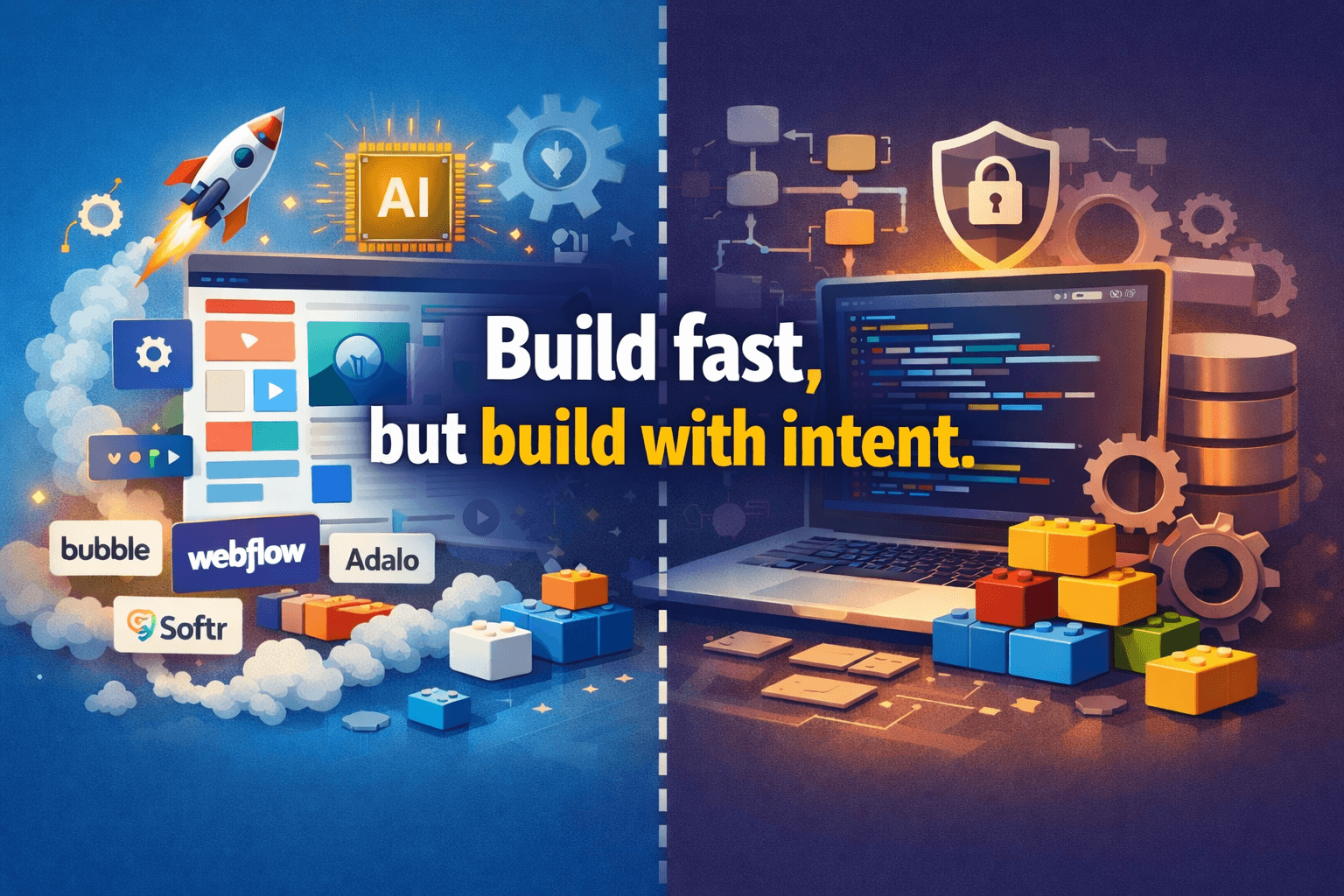
No-code has completely changed how products get built today. Founders no longer have to wait for months or depend entirely on developers to bring an idea to life. Tools like Bubble, Webflow, Glide, Adalo, and Softr have made it possible to go from concept to working product in a matter of days. When AI is layered into this, the speed increases even further, often turning rough ideas into functional prototypes with minimal effort.
This shift feels revolutionary because it removes traditional barriers. However, while the tools have evolved, the fundamentals of building a reliable product have not changed. Ignoring those fundamentals is where most problems begin.
Why No-Code Works So Well in the Early Stage
The biggest advantage of no-code is how quickly it allows you to test ideas. Instead of spending time and money building a full product, you can create a working version, put it in front of users, and understand what actually works. This reduces risk and makes early decision-making far more grounded.
For many founders, this translates into:
- Faster launch timelines without waiting on development cycles
- Lower initial investment, often limited to platform subscriptions
- The ability to iterate quickly based on real user feedback
- Independence from technical teams during the early stages
This is why no-code has become a natural starting point for MVPs, internal tools, and early-stage SaaS products. In competitive markets, this speed can be the difference between gaining traction and being overlooked.
Where Speed Starts Creating Problems
The same speed that makes no-code powerful can also create long-term issues if not handled carefully. When systems are built quickly without proper planning, they often lack the structure needed to scale or evolve.
Some of the most common challenges begin to surface as the product grows:
- Scalability limitations start appearing when user numbers increase or workflows become more complex
- Vendor dependency becomes a concern because the entire product relies on a single platform
- Technical debt builds through quick fixes, unstructured logic, and poorly planned data models
- Security gaps emerge when edge cases and compliance requirements are not fully considered
- Customization limits become visible when the product needs functionality beyond what the platform supports
These issues do not usually appear in the early stages. They develop gradually and often become critical only when the product starts gaining real traction.
What Structured Development Still Brings to the Table
Traditional development continues to offer advantages that no-code cannot fully replace. It provides complete control over how a system is built, how it performs, and how it scales over time. This level of control becomes essential when dealing with complex logic, large datasets, or strict security requirements.
The trade-off is clear. Building with code requires more time, higher initial investment, and technical expertise. In return, it offers flexibility, ownership, and a stronger foundation for long-term growth.
This is why the discussion is not about choosing one approach over the other. It is about understanding when each approach makes sense.
How Founders Are Approaching This in 2026
A more balanced approach is becoming common. Instead of relying entirely on one method, founders are combining the strengths of both no-code and traditional development.
A few consistent practices stand out:
- Starting with no-code to validate ideas and gather early feedback
- Designing data structures and workflows carefully, even within visual tools
- Paying attention to security and performance from the beginning
- Documenting systems to avoid confusion as complexity increases
- Recognizing the right time to transition or expand beyond no-code
This approach reduces the risk of rework while still taking advantage of the speed that no-code offers.
Why Hybrid Approaches Are Becoming More Practical
As products evolve, a hybrid model often becomes the most practical solution. No-code can continue to handle areas where speed and flexibility are important, such as landing pages or internal tools. At the same time, core systems that require performance, scalability, or deep customization can be built using traditional development.
AI tools are also influencing this shift. While they can generate code and assist in building systems faster, they still require structured thinking and oversight. Without that, the complexity simply moves from one layer to another.
Choosing the Right Approach Based on Stage
The decision is less about preference and more about context. Early-stage products benefit from speed and experimentation, making no-code a strong choice. As requirements become more complex, the need for structured development increases.
In many cases, the transition is not immediate. It happens gradually, with different parts of the system evolving at different speeds. Understanding this progression allows founders to make better decisions without unnecessary delays or costly rebuilds.
To know more watch: